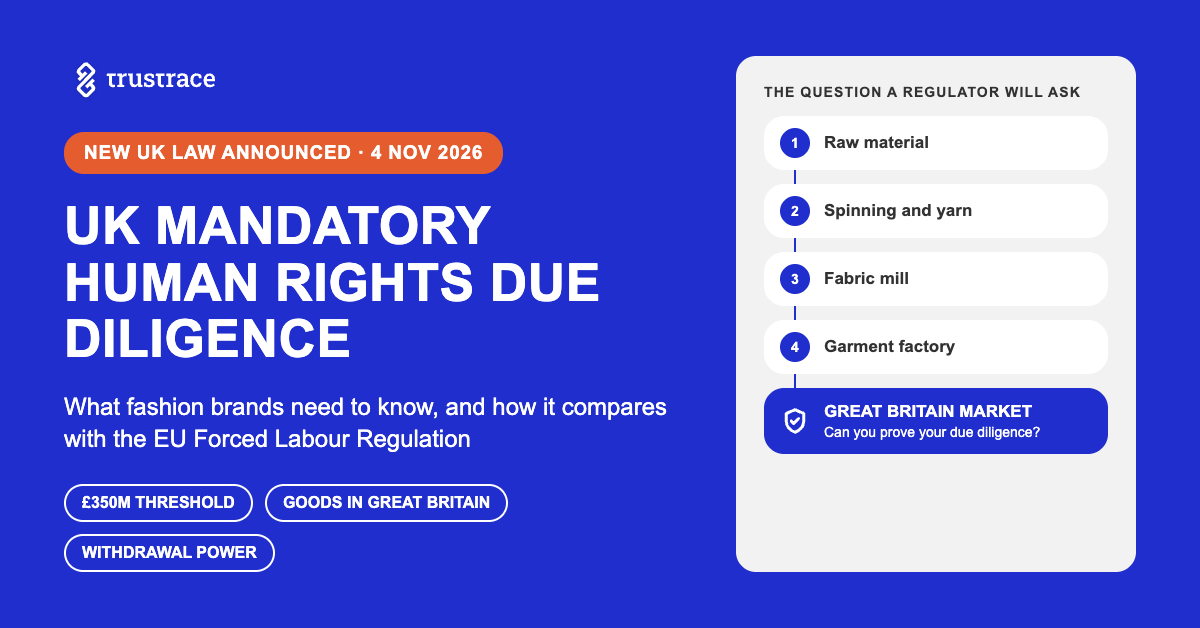
On 4 November 2026, the UK Government announced that it will legislate for mandatory human rights due diligence. For fashion brands and retailers selling into the UK, this marks a clear shift: from publishing a modern slavery statement to proving that you identify and address human rights risks in your supply chain.
Mandatory human rights due diligence (mHRDD) is a legal duty for companies to identify, prevent and address human rights abuses across their operations and supply chains, rather than only report on them. The UK regime will sit alongside the EU Forced Labour Regulation, and the two work differently in one important way.
This article covers what the UK announced, who is in scope, how it compares with the EU, and what you can do now.
AT A GLANCE
The UK will introduce mHRDD for companies with more than £350 million in turnover, and give a regulator the power to remove goods made with forced labor from the Great Britain market. Unlike the EU Forced Labour Regulation, withdrawal depends on both forced labor and a failure of due diligence, which makes documented due diligence your strongest defense. No bill has been published yet, but the direction is set, and the data you need is the same data the EU already asks for.
WHAT DID THE UK GOVERNMENT ANNOUNCE?
The UK Government committed to introducing a mandatory human rights due diligence regime covering services across the UK and goods in Great Britain. The commitment came in a written ministerial statement on 4 November 2026, following the government's review of Responsible Business Conduct.
The review found the UK's current framework for preventing forced labor fragmented and overly reliant on voluntary action and reporting. Under the Modern Slavery Act 2015, large companies publish an annual statement, but the law does not require them to act on what they find. The new regime moves the UK from transparency to obligation.
Two details matter for scoping your response. The duty covers all human rights abuses, not only forced labor. And environmental due diligence is not included, despite calls from the British Retail Consortium and civil society groups to cover it.
WHICH COMPANIES WILL BE IN SCOPE?
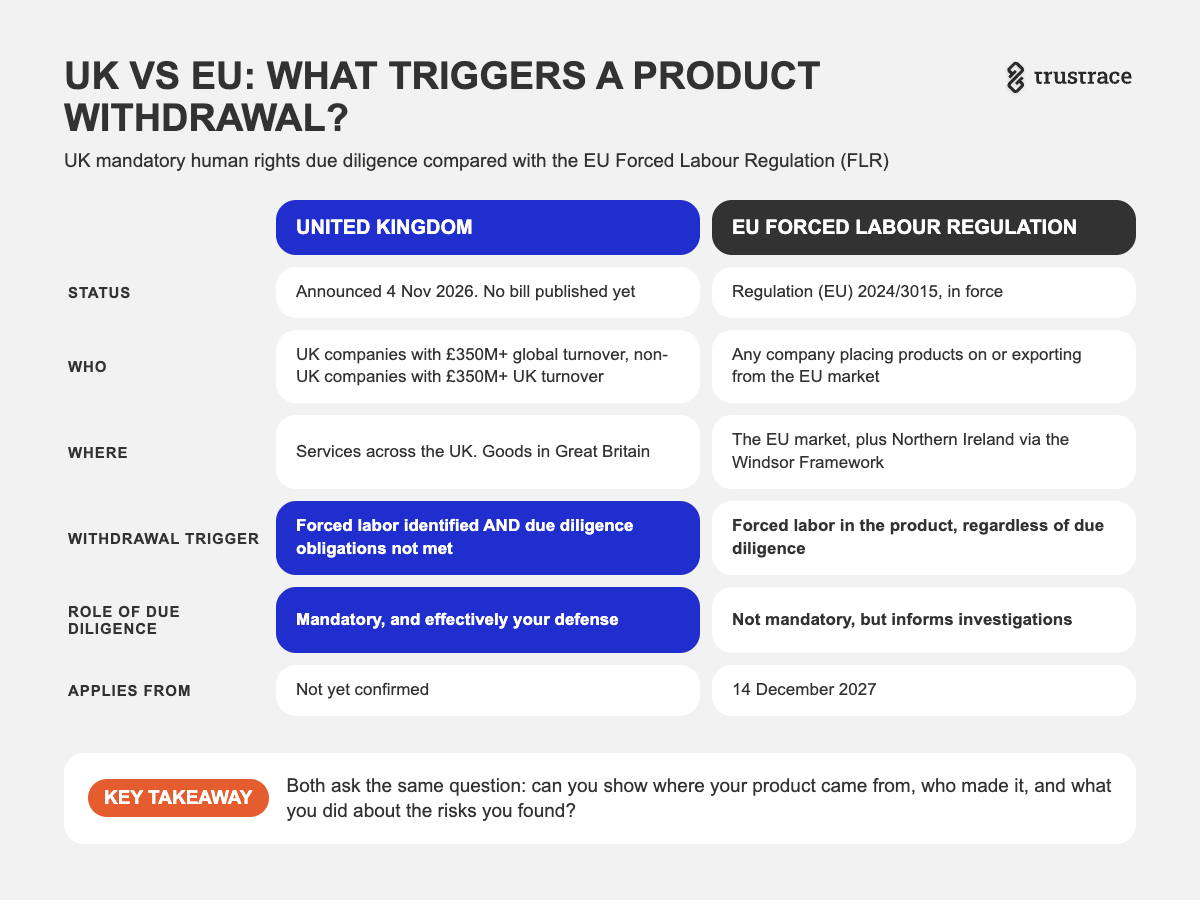
The regime will apply to large companies above a £350 million turnover threshold, whether or not they are headquartered in the UK:
- UK businesses with global turnover above £350 million
- Non-UK businesses with more than £350 million in UK turnover
- Timing. No timetable has been set. The government will legislate “as soon as parliamentary time allows.” At least one law firm has suggested the UK may aim to align with the EU FLR’s December 2027 application date, but this is not confirmed.
- The regulator. Which body will enforce the regime and with what powers.
- Penalties and liability. The level of sanctions and whether there will be civil liability.
- The duty itself. What exactly companies must do, and what happens to the current modern slavery statement.
For your brand, this means EU and US companies with significant UK sales will be in scope alongside UK retailers. Being headquartered elsewhere is no exemption.
Geography adds a layer. The goods obligations apply in Great Britain (England, Scotland and Wales). In Northern Ireland, the EU Forced Labor Regulation will apply under the Windsor Framework. If you sell across the whole UK, you will face two different forced labor regimes for goods within one country.
HOW WILL THE UK REMOVE FORCED LABOR GOODS FROM THE MARKET?
A regulator will be able to investigate companies suspected of placing goods made with forced labor on the Great Britain market, and direct those goods to be withdrawn. That power applies where forced labor is identified and the company has not met its due diligence obligations.
Which body will act as regulator, what investigatory powers it will have and what penalties will apply have not yet been set out. These details will come with the legislation.
HOW DOES THE UK APPROACH COMPARE WITH THE EU FORCED LABOUR REGULATION?
The key difference is the role of due diligence. The EU Forced Labour Regulation (FLR), Regulation (EU) 2024/3015, prohibits products made with forced labor from the EU market from 14 December 2027, regardless of how much due diligence a company has done. Due diligence is not mandatory under the FLR, although it informs how authorities prioritize and assess cases.
In Great Britain, withdrawal is conditional on two things: forced labor in the product, and a failure to meet due diligence obligations. The result: in the UK, documented due diligence is effectively your defense. In the EU, it is how you find and fix problems before an authority does.
Here's where the two regimes converge. Both ask the same underlying question: can you show where your product came from, who made it, and what you did about the risks you found? A brand that can answer that with evidence is prepared for both, and for the Corporate Sustainability Due Diligence Directive (CSDDD) as well.
WHAT IS STILL UNKNOWN?
The UK has announced its intent, but no bill has been published. Several questions remain open:
The question isn't whether the UK will require due diligence. It's whether your evidence will be ready when the detail lands.
KEY ACTIONS FOR BRANDS
- Check your UK exposure. Confirm whether your UK or global turnover crosses the £350 million threshold, and which entities place goods on the Great Britain and Northern Ireland markets.
- Look beyond tier 1. Forced labor risk usually sits deeper in the supply chain, in raw material processing and fabric production. Map the facilities behind your products, not only your direct suppliers.
- Document your due diligence. Record how you assess risks, what actions you take and how you follow up. Under the UK model, this record is what a regulator will test.
- Build one evidence base. The UK regime, the EU FLR and the CSDDD draw on the same supplier and product data. Collect it once and use it across all three.
- Watch for the bill. Scope, timing and penalties will be defined in the legislation. Plan for the direction now and refine once the text is published.
FREQUENTLY ASKED QUESTIONS
Is UK mandatory human rights due diligence law yet?
No. On 4 November 2026 the UK Government committed to introduce the legislation, but no bill has been published and no implementation date has been confirmed.
Which companies will the UK due diligence law apply to?
It will apply to UK businesses with global turnover above £350 million and non-UK businesses with more than £350 million in UK turnover. Services are covered across the UK and goods in Great Britain.
How is the UK law different from the EU Forced Labour Regulation?
The EU FLR bans products made with forced labor regardless of the due diligence performed. In Great Britain, a regulator can withdraw goods only where forced labor is identified and the company failed its due diligence obligations.
Does the UK law cover environmental due diligence?
No. The announced regime covers human rights, including forced labor, but not environmental impacts. Retailers and civil society groups have criticized this omission.
TALK TO TRUSTRACE
TrusTrace helps you build one data foundation for many regulations. With supplier-level traceability and due diligence evidence in one place, you can answer UK, EU FLR and CSDDD requirements from the same verified source. Check out our risk and due diligence solution or speak with one of our experts.
Disclaimer: This content is for informational purposes only and does not constitute legal advice. Please consult legal professionals for guidance specific to your situation.