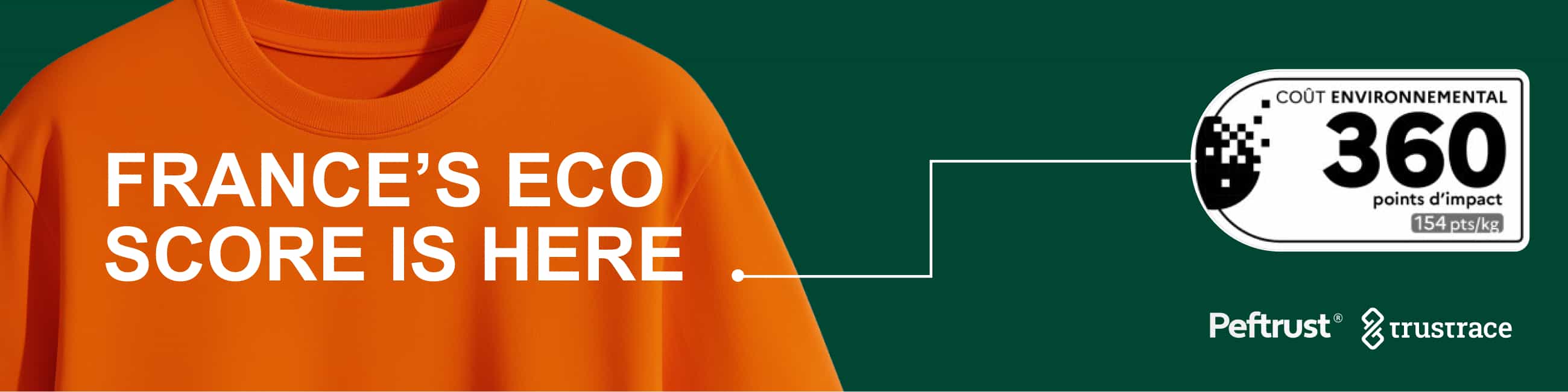
The French Eco-Score became a voluntary environmental cost labeling scheme on October 1st, 2025. If an apparel brand wants to make environmental claims on their products, such as carbon footprint or water footprint statements, for products sold in France, they must follow the French framework to declare the environmental cost including the Environmental Cost label.
While voluntary today, the October 2026 public provision allowing third parties to declare calculations on behalf of brands creates a clear strategic timeline: act now and control your environmental narrative, or risk someone else defining your products' environmental performance for you.
Based on insights from our recent French Eco-score webinar with Peftrust®, this article provides guidance on the right execution strategy through three critical actions your brand needs to take. But first, let's review what the French Eco-Score requires and why it matters.
Understanding the Eco-Score labeling Scheme
Let’s answer what’s on everyone’s mind: is the eco-score mandatory? The answer is no.
As mentioned in this explanation on the French Eco-Score, publishing an eco-score is technically voluntary, but the moment you make environmental claims about your apparel products that are sold in France (i.e. carbon footprint statements, eco-design labels, sustainability ratings, environmental production claims), you must comply with the French framework.
This applies to every brand selling apparel in France, regardless of size, origin, or business model. There's no threshold that exempts smaller brands, and it doesn't matter whether you sell directly to consumers or through retailers. The regulation covers new clothing and textile products sold in the French market. Note that footwear, accessories, and household textiles remain out of scope for now.
The regulation includes a significant incentive mechanism. Starting October 1, 2026, third parties such as NGOs, media organizations, retailers, competitors, can publish eco-scores for any product that doesn't already have one registered. They'll use publicly available information and industry averages, which means the scores may not reflect your actual supply chain performance or the sustainability investments you've made.
There is also a strategic option that some brands are considering: registering product scores in the portal without actively using them in consumer-facing communication. In practice, early registration can help brands maintain control over how and when environmental information is disclosed, even if they are not yet ready to publish scores publicly.
French Eco-score vs. European PEF
French eco-score and European Product Environmental Footprint (PEF) methodology are two different systems serving different purposes, and the scores they produce are intended to be directly comparable.
While both are grounded in life-cycle assessment principles, they differ in methodological choices, data sources, and how results are normalized and presented.
For example: the way water use is weighed is very different in each calculation. The PEF methodology is at the product level, whereas the often presents results normalized per 100 g of product for apparel categories.
The French Eco-score relies on national reference datasets curated by ADEME (Empreinte), while the European PEF methodology is based on the Environmental Footprint (EF) database. Over time, the French framework has increasingly aligned with EF datasets. Early design choices were influenced by a combination of factors, including data governance, openness, and licensing considerations, particularly in the context of a government-run consumer labelling scheme.
As Laurent stated, "PEF is the cake. It's the foundation. French eco-score is the cherries, the icing, and the toppings." PEF provides detailed, granular precision for internal eco-design, product development, and corporate reporting. It supports Science Based Targets, CSRD reporting, and identifying where your biggest impact reduction opportunities exist. French eco-score adapts that foundation for consumer communication—simplifying complexity into information shoppers can use at the moment of purchase.
Chance of Convergence
The encouraging news is convergence. The French authorities have communicated interest in aligning with the European methodology, but it’s still yet to be confirmed. The European Commission is treating French eco-score as a large-scale pilot, providing practical lessons on what works and what doesn’t in real-world consumer environmental labelling. Meanwhile, PEF methodology is being revised through 2025-2027 to incorporate elements like microfibers and emotional durability that France has pioneered.
3 Strategic Steps to Take for Eco-Score
Step 1: Assess Your Primary Data Access
Getting trustworthy data across the supply chain continues to be a brand’s biggest challenge.
As Navya Mathur at TrusTrace explains, “Your ability to calculate accurate eco-scores depends entirely on whether you have primary data from your supply chain. When you don't provide actual supply chain information, the Ecobalyse calculation engine defaults to industry averages. These averages assume generic production methods, typical energy grids, and standard transportation distances. If you've invested in renewable energy at your finishing facilities, optimized logistics to reduce transportation, or implemented lower-impact processing methods, none of that appears in your score when you're using generic data.”
Start by auditing what you currently know about your products.
- Can you identify the country-level locations where knitting, finishing, and assembly occur for each product?
- Do you have accurate material composition breakdowns that add up to 100% and account for every fiber?
- Can you verify finished product weights?
These data points determine whether you can calculate scores that reflect your actual performance or whether you're stuck with industry averages that may undervalue your sustainability work. A traceability solution like TrusTrace helps you conduct this at scale.
For most brands, the answer is mixed. You might have detailed composition data because your product development team maintains tech packs. You might have assembly locations because you work directly with tier one manufacturers. But tracing back to knitting and finishing locations often requires going deeper with supply chain mapping into tier two and tier three suppliers—facilities you may not have direct relationships with.
This assessment reveals your data gaps, which then informs your supplier engagement strategy. You're not starting from zero, but you need to be honest about what you have and what you need to collect.
Step 2: Evaluate and Enable Your Supplier Readiness
Brands succeeding with French eco-score aren't simply sending data requests and waiting for responses. They're treating supply chain transparency as a partnership.
Your suppliers are being asked to provide information via various different scorecard formats that they may not typically track or share. They're receiving similar requests from multiple brands simultaneously. They may not understand why this information matters or how it will be used. And they're often working with limited resources and competing priorities. Onboarding is critical for success of any traceability initiative.
Effective supplier enablement has three components.
- First, you need tools that make data sharing simple. Configurable data collection platforms let you send structured requests that guide suppliers through exactly what information you need, in what format, and by when. Automated reminders keep requests moving without your team having to manually follow up with hundreds of suppliers.
- Second, you need training and communication that helps suppliers understand the context. When suppliers understand the "why," they're more likely to prioritize accuracy over speed.
- Why are you asking for knitting location? Because it affects the energy grid carbon intensity used in your eco-score calculation.
- Why does fiber composition need to be precise? Because different materials have dramatically different environmental footprints.
- Why are you asking for knitting location? Because it affects the energy grid carbon intensity used in your eco-score calculation.
- Third, you need systems that reduce the burden on suppliers over time. If you're asking a fabric mill for their finishing location once, capture that information in a way that lets you reuse it for every product you source from that facility. Use automation and artificial intelligence to extract information from documents suppliers already have rather than asking them to create new reports. Build on collected data rather than starting fresh with each new request.
This approach can facilitate more than calculating French eco-scores. The primary data you collect for this regulation will serve Product Environmental Footprint calculations, Digital Product Passport requirements, and whatever environmental regulations come next across European markets. You're building data infrastructure that can be used long-term, not just for a season.
Step 3: Decide Your Timing Strategy
With an understanding of what data you have and a plan for collecting what you're missing, the final strategic decision is timing. As Bruno Mattia at TrusTrace informed, it will come down to a choice between three approaches, each with different risk and opportunity profiles.
The first approach
Your brand registers scores now to block third-party publication, even if you're not ready to display them publicly. This is the risk-mitigation strategy. You maintain control over your environmental information without committing to public disclosure before you're confident in your data and messaging. You can take the time to verify accuracy, identify improvement opportunities, and develop communication strategies while knowing that no third party can publish scores on your behalf after October 2026.
The second approach
You choose full public disclosure as a competitive differentiator. Brands choosing this path are using eco-scores as a transparency signal and a demonstration of environmental leadership. They're publishing scores on e-commerce pages, including QR codes on physical labels that link to detailed product information, and using the scores in marketing communications. This approach works best when you have high confidence in your data accuracy and when your scores compare favorably within your product categories.
The third approach
The third approach is waiting—continuing to assess, planning to act closer to the October 2026 deadline or even after mandatory enforcement arrives. This carries the highest risk. After October 2026, third parties can publish scores for your products based on publicly available information and industry averages. Those scores may not reflect your actual performance. Once they're public and associated with your brand, you're playing defense, trying to correct the record rather than controlling your own story. You also lose the opportunity to learn from early implementation and identify product improvements before they become publicly visible.
The current market momentum strongly favors early action. There are 18 800 publicly available scores already in the portal representing brands that have made their choice. They're building expertise with the methodology, establishing data collection processes with suppliers, and positioning themselves as environmental transparency leaders.
The Infrastructure Question: Manual vs. Automated
Calculating scores for a handful of products might work with manual processes, but scaling to hundreds or thousands of SKUs, or 10,000+ for that one early actor, requires automation. The direct submission option to the Ecobalyse portal is free and available to all brands with options to do this manually on the government website, or automatically via the Ecobalyse API, for programmatic data submission and impact calculation. With the right credentials, brands and their technical partners can integrate this into automated workflows to support large catalog compliance.
For brands managing large catalogs, integrated systems create automated workflows. Supply chain data collected through traceability platforms like TrusTrace flows directly into calculation engines that apply the French framework such as Peftrust®, then results push to the Ecobalyse portal via API integration. This handles volume, ensures consistency, and creates the audit trail documentation that verification requires.
The strategic value is clear: the same primary data you collect for French eco-score serves multiple regulatory requirements. Configure your data collection to capture what you need now, then expand it for Product Environmental Footprint, ESPR, and future Digital Product Passport requirements. You're not building separate systems for each regulation—you're building flexible infrastructure that adapts as requirements evolve.
Start with Eco-Score and prepare for PEF
When considering voluntary disclosure under the French eco-score, you need to address three strategic imperatives:
-
First, honestly assess your primary data access—your gaps inform your supplier engagement strategy and determine whether your scores reflect actual performance or industry averages.
-
Second, evaluate your supplier readiness by providing context, simple data-sharing tools, and systems that reduce their burden through information reuse.
-
Third, decide your timing strategy: will you register scores now and control your environmental narrative, or wait and risk others defining your products' performance after October 2026?
The data infrastructure you build for French eco-score becomes your foundation for everything coming next across European markets (PEF, ESPR and DPP, etc). With French-European methodology convergence expected by 2027-2028, the work you do today will help you secure your market access tomorrow.
Ready to start publishing Eco-Scores?
TrusTrace partners with Peftrust® to help brands collect primary supply chain data at scale, calculate accurate scores aligned with French methodology, and build flexible infrastructure for the broader landscape of EU environmental regulations. Contact us to discuss your implementation approach.
Disclaimer: This content is for informational purposes only and does not constitute legal advice. Please consult legal professionals for guidance specific to your situation.