The EU Deforestation Regulation (EUDR) has created a wave of questions from food and beverage companies working to understand their compliance obligations. Following the one-year delay that moved implementation to December 30, 2026 for large enterprises, brands now have crucial time to address these complexities—but the questions remain pressing.
This blog series answers the most common questions that TrusTrace and Ohana Public Affairs received from the field concerning EUDR. If you prefer a webinar format, you can watch this webinar co-hosted by our teams that answered the most common concerns from enterprise brands. Find the link to Common Questions Part 2 at the end of this blog.
Updates since October 2025 summarized by Natalia at Ohana Public Affairs:
“Let’s recap what other changes have been introduced to the final text by the European Council and the Parliament in the final stages of negotiations aside from the one-year delay for large enterprises:
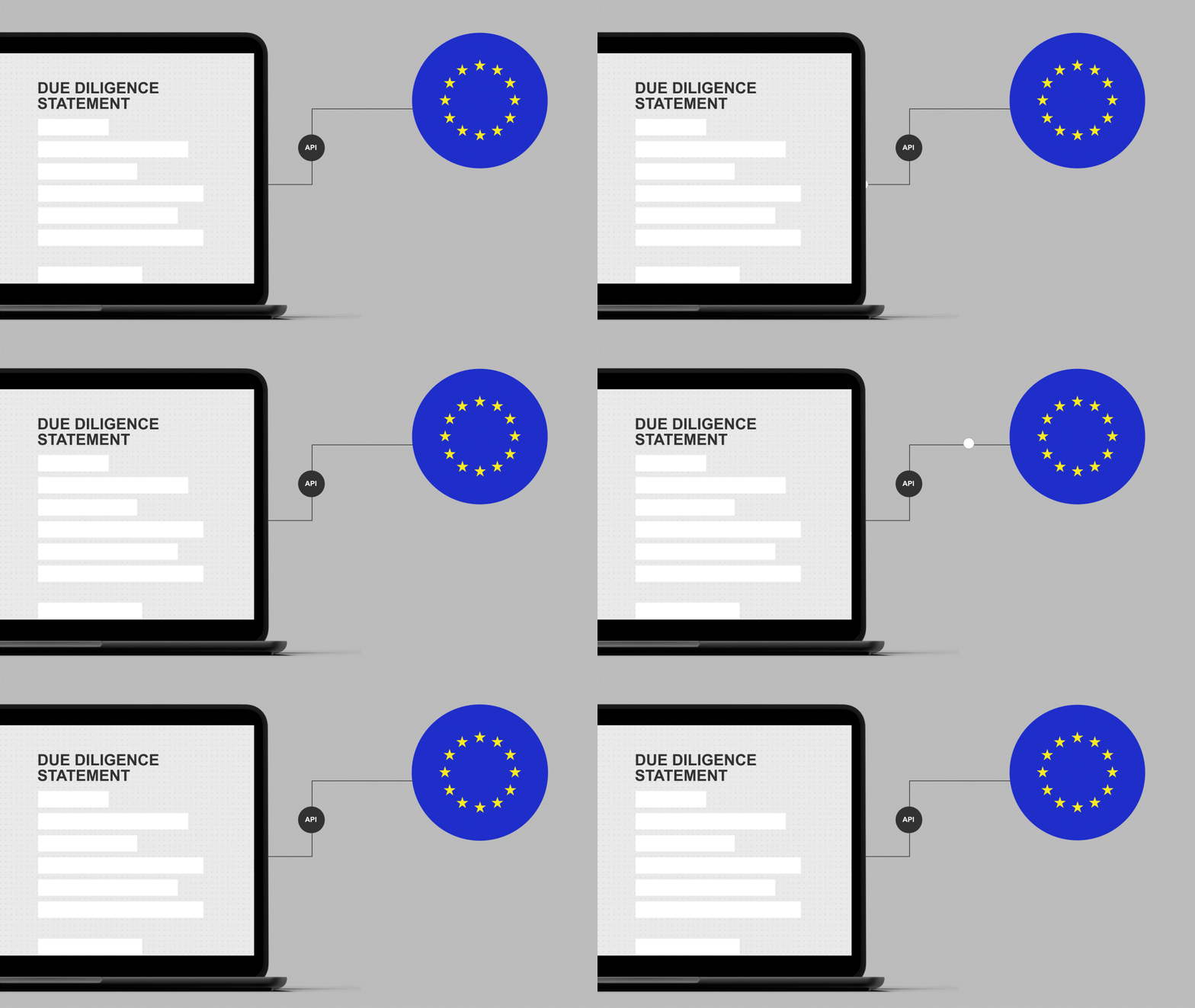
- The obligations of operators and traders have been further simplified. Operators and traders do not need to submit due diligence statements, nor to pass on the reference numbers further in the supply chain. Only the first actor downstream will need to submit a due diligence statement and collect a due diligence reference number.
- Micro and small primary operators from low-risk countries do not need to submit the due diligence statement (DDS). They can submit a one-off simplified declaration.
- Adding to the evolving landscape, the Commission will publish a simplification report by April 2026 to assess the burden on smaller operators and suggest further improvements. If needed, this could even come with a new legislative proposal, signaling that the rulebook may not be set in stone just yet.
- And in a move that caught many by surprise, books, newspapers and printed materials will now be excluded from the regulation. This exemption sets a precedent ahead of the review clause and may open the door for other sectors to push for similar treatment. But the door swings both ways—leather expected be added to the scope. For brands, the message is clear: the regulatory landscape is shifting fast, and standing still isn't an option.
Q: What commodities are in scope for food and beverage companies?
A: EUDR directly impacts five core commodities and derived products used across the food and beverage industry:
- Coffee: Beans and all derived products including instant coffee, extracts, and oils
- Cocoa: Beans, powder, butter, paste, and all chocolate products
- Palm Oil: Crude and refined palm oil, palm kernel oil, and hundreds of derivatives including stearic acid, glycerin, and emulsifiers
- Soy: Beans, meal, oil, and protein products used across food manufacturing
- Rubber: Natural rubber in food-grade gaskets, closures, and processing equipment
- Cattle:
The complexity comes from derivatives and what is placed or made available on the market. If your company is placing on the market a product which contains derivatives from palm oil, but which is not part of Annex I of EUDR, the product would be out of scope. As Pauline observed during the webinar, "In some cases, it's not as simple. We will see so many different scenarios even within companies and within product ranges."
Are you in scope of EUDR? Find out with the TrusTrace Guide to HS Codes in scope.
Q: Are we an operator or a downstream operator—and why does it matter?
A: Understanding your role is crucial because it determines your obligations. The Commission's simplification proposal introduced the "downstream operator" category with significantly lighter requirements.
You're an OPERATOR if: You're the first entity placing EUDR commodities on the EU market
Example: A coffee roaster importing green coffee beans directly from Colombia
Your obligations:
- Conduct comprehensive due diligence
- Collect plot-level geolocation data
- Submit due diligence statements (DDS)
- Ensure negligible deforestation risk
- Verify legal production
- Register in EU information system
You're a DOWNSTREAM OPERATOR if: You're working with commodities that already have existing due diligence statements
Example: A chocolate manufacturer using cocoa butter that was already imported by another operator with an existing DDS
Your obligations:
- Do NOT need to conduct new due diligence (unless no DDS exists for a specific ingredient)
- Do NOT need to submit new due diligence statements
- Do NOT need to pass on the reference numbers further in the supply chain. Only the first actor downstream will need to collect a due diligence reference number.
Natalia clarifies: "Downstream operator is the second or further downstream actor who works with commodities or products that have already been placed on the market and due diligence statement for which have already been filled in. That's why the role of the downstream operator and the duties are much lighter than operator."
Q: What about soy in cattle feed?
A: This is a critical question for any company with meat or dairy in their supply chain. All soy placed on the EU market, including soy used as animal feed, must comply with the deforestation-free and legality requirements.
This means operators need to provide geolocation and due diligence information for the land where the soy feed was grown, just as they would for soy as a food or industrial product. The regulation doesn't distinguish between soy for direct human consumption and soy for animal feed—if it enters the EU market, it's in scope.
For meat and dairy producers, this creates an additional layer of complexity: you must trace not just your direct ingredients, but also the feed sources for livestock.
Q: For products with multiple EUDR ingredients, who does due diligence on what?
A: This is one of the most common questions from food manufacturers. Consider a chocolate bar containing cocoa powder, cocoa butter, cocoa paste, and soy lecithin.
Natalia provides the framework: "When the chocolate bar is produced, the producer is using different ingredients, among which three are in scope of Annex 1. If cocoa butter and cocoa paste have already undergone due diligence process and there are existing due diligence statements, but cocoa powder is imported directly, so there is no other actor who has done due diligence—in this case, even downstream operators have to submit due diligence statement and conduct due diligence on cocoa powder."
The principle: Due diligence must be performed once for each ingredient when it first enters the EU market. If an ingredient already has a due diligence statement (DDS) from an upstream operator, the first downstream operator will need to collect the reference number rather than repeating the submission process. But if any ingredient lacks a DDS, you must conduct due diligence on it—even if you're otherwise a downstream operator.
Important nuance: You only need to cover ingredients that fall under in-scope HS codes in Annex 1. Using the chocolate bar example, you'd need DDS for cocoa-related HS codes (cocoa butter, cocoa paste, cocoa powder) but not for other ingredients like sugar or vanilla that aren't EUDR commodities, even if they're in the same product.
Q: For processed ingredients—do we need traceability at every processing stage?
A: For in-scope commodities and their derivatives, you need traceability back to the plot(s) that supplied those volumes. Supplier declarations are helpful inputs, but they're not substitutes for actual traceability.
Your compliance approach should combine:
- Chain-of-custody links across all processing steps
- Volume and balance checks to ensure you're not claiming more traced material than actually exists (no overselling)
- Geolocation evidence for the upstream plots that ultimately supply the ingredient
Natalia explains: "If you are placing a commodity on the market and it's in the Annex I, you need to ensure full traceability." However, she notes that "this commodity could end up in multiple applications which are not in scope of the legislation, but it doesn't mean that the operator doesnot have to perform due diligence."
Practical example: If you're importing crude palm oil and processing it into stearic acid (both in Annex 1), you need full traceability as the operator. If someone buys your stearic acid and uses it in a cleaning product (not in Annex 1), they have no EUDR obligations—but you still had to comply at your stage.
Q: Our supply chains are mass balance—what are our options?
A: This is perhaps the most challenging question facing food and beverage companies. Natalia is direct: "Mass balance doesn't respond to the requirements of the regulation. These volumes cannot go to the European market when the EUDR enters into application."
The regulation requires product segregated supply chains with full traceability to the plot of land. However, the one-year delay provides time for systematic transition.
Recommended approach:
"Prioritize high risk volumes and look at the benchmarking list of the European Commission" Natalia advises. "Rather than looking at the low risk, look at the standard risk, high risk. Prioritize those countries and the biggest volumes that you're sourcing."
Start with:
- High-volume commodities from standard and high-risk countries
- Commodities where mass balance is most prevalent in your supply chain
- Lower-volume ingredients and low-risk sources
resources for IMPLEMENTATION
These questions represent just a fraction of the complexity food and beverage companies face with EUDR compliance. The good news? You don't have to navigate this alone. As Natalia emphasizes: "Work with your suppliers because it's a big transformation. It's a big change that they need to go through, so collectively this can be done."
For deeper guidance on implementation strategies, watch the full EUDR webinar hosted by TrusTrace and Ohana Public Affairs. When you're ready to build your compliance program, TrusTrace offers validated solutions for systematic, scalable deforestation compliance—from supply chain mapping through DDS generation and EU system integration. Ohana Public Affairs offers support to companies in EU policy monitoring, influencing and preparation for implementation of the EU laws. Ohana Public Affairs can help you unpack what is happening in Brussels and how it might affect your company.
Go to Part 2
To continue to more common questions from Food & Beverage Brands including answers about palm oil, SMEs and intermediaries, visit Part 2 hosted by our friends at Ohana Public Affairs.
.jpg?width=1632&height=375&name=tt-web-ui-2025-12-f%26b-brands-questions-eudr-part-1%20(1).jpg)
Ready to address your specific EUDR questions? Connect with TrusTrace to explore how our platform and expert guidance can help you build efficient, effective compliance programs.