The EU Deforestation Regulation (EUDR) has created significant questions for fashion and textile companies trying to understand which materials fall under compliance and what their obligations are. With the December 30, 2026 deadline for large enterprises now set following a one-year delay, brands have critical time to address these complexities, but clarity remains essential.
This blog series answers the most common questions on EUDR that TrusTrace and Ohana Public Affairs received from fashion and textile companies. If you prefer a webinar format, you can watch this webinar co-hosted by our teams that answered the most common concerns from enterprise brands. Find the link to Common Questions from Fashion and Textiles Part 1 at the end of this article.
A quick reminder of UPDATES SINCE OCTOBER 2025 SUMMARIZED BY OHANA PUBLIC AFFAIRS:
Let’s recap what other changes have been introduced to the final text by the European Council and the Parliament in the final stages of negotiations aside from the one-year delay for large enterprises:
- The obligations of operators and traders have been further simplified. Operators and traders do not need to submit due diligence statements, nor to pass on the reference numbers further in the supply chain. Only the first actor downstream will need to submit a due diligence statement and collect a due diligence reference number.
- Micro and small primary operators from low-risk countries do not need to submit the due diligence statement (DDS). They can submit a one-off simplified declaration.
- Adding to the evolving landscape, the Commission will publish a simplification report by April 2026 to assess the burden on smaller operators and suggest further improvements. If needed, this could even come with a new legislative proposal, signaling that the rulebook may not be set in stone just yet.
- And in a move that caught many by surprise, books, newspapers and printed materials will now be excluded from the regulation. This exemption sets a precedent ahead of the review clause and may open the door for other sectors to push for similar treatment. But the door swings both ways—leather expected be added to the scope. For brands, the message is clear: the regulatory landscape is shifting fast, and standing still isn't an option.
Q: For materials that go through multiple processing stages, do we need origin traceability for every step?
A: The requirement is traceability back to the original plot of land, but you don't necessarily need to repeat due diligence at every transformation if a DDS already exists.
Natalia's guidance: "If you're working with a certain commodity, you might not know where it will end up. So you don't need to look that far, but if you are placing on the market a commodity and it's in the list, you need to ensure the full traceability."
Practical application for leather:
- Raw hide imports: Operator obligations with full traceability to cattle origin
- Tanned leather from those hides: Can reference existing DDS if already established
- Leather goods manufacturing: Downstream operator if leather has existing DDS
The key is understanding your role in the supply chain and what you're placing on the market at your specific stage.
Q: What relief is available for SMEs?
A: Small and medium fashion enterprises have meaningful provisions:
Extended deadline: June 30, 2027 (six months after large companies)
Simplified obligations: SMEs qualifying as primary producers from low-risk countries face considerably lighter requirements—no formal due diligence statement, just a simplified declaration.
Reduced scrutiny: "Competent authorities, when they're doing checks, SMEs are not mentioned there at all," Natalia notes. "So it says that they will be checking on traders and operators, non-SMEs. So probably they will not be prioritising SMEs for checks."
Additional relief: SMEs "don't have to register in the information system or do verification of due diligence conducted in the previous stages of the supply chain, even if they have received substantiated concerns about it."
Looking for a traceability solution to expedite your mapping and tracing? Check out TrusTrace for SMEs.
Q: How do we handle wood-based materials like viscose and modal?
A: Wood-based cellulosic fibers are not in scope of EUDR, meaning:
- Viscose
- Modal
- Lyocell
- Any other wood-derived textile fibers
Why they're out of scope:
EUDR Annex I specifically lists which wood products are covered under the "Wood" commodity. The regulation covers:
- Wood products (HS chapters 44, 94, etc.)
- Pulp and paper products (HS chapters 47, 48, 49)
However, wood-based cellulosic textile fibers fall under HS chapters 54-55 (man-made filaments and staple fibers), which are NOT listed in EUDR Annex I.
According to EUDR Article 1(1) and FAQ 2.2, products are only in scope if they:
- Are listed in Annex I, AND
- Contain or are made from the relevant commodities listed in the corresponding left column
Since textile fibers are not listed in Annex I, they are not subject to EUDR requirements.
IMPORTANT DISTINCTION: While these fibers are derived from wood, once they undergo chemical processing into textile fibers, they are classified as textiles, not wood products, and therefore fall outside EUDR scope.
Are the commodities you work with in scope of EUDR? Find out with the TrusTrace Guide to HS Codes in scope.

Q: What tangible Data deliverables do we need for compliance?
A: EUDR compliance requires specific documentation:
- Due Diligence Statements (DDS): For operators placing materials on the market
- Geolocation data: Plot-level coordinates for all source materials (cattle grazing land, forests, rubber plantations)
- Supply chain mapping: Complete visibility from source to your facility
- Risk assessment documentation: Evidence of deforestation and legality checks, including satellite monitoring
- DDS reference numbers: To pass through your supply chain to downstream operators
- Record retention: Documentation must be kept for five years
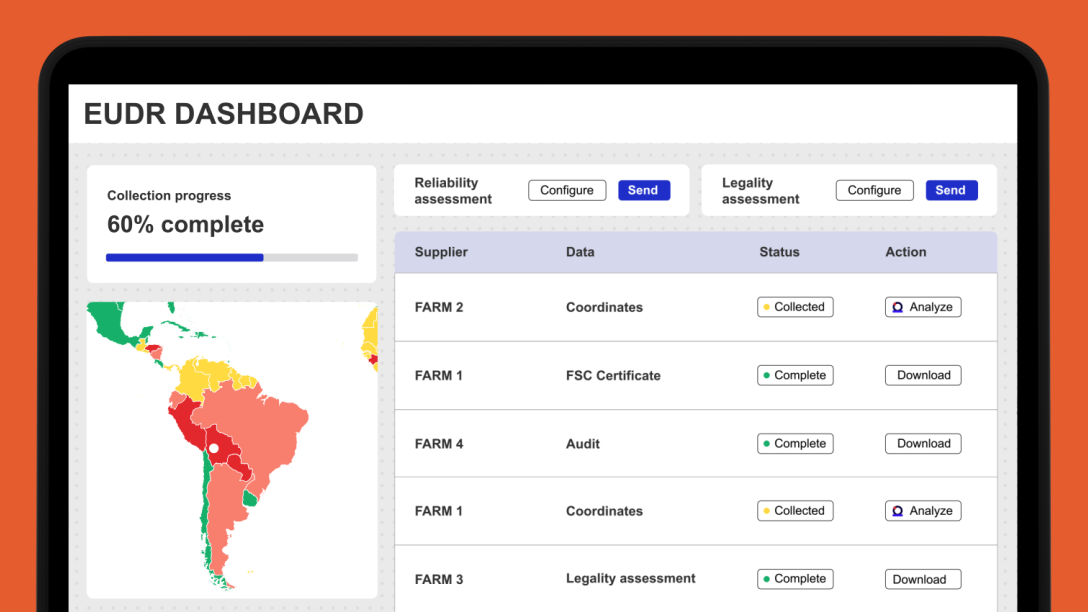
Image illustrating an example of the data requirements of EUDR which can be collected using TrusTrace
Q: We're not fully ready—where should we start?
A: Pauline outlines the no-regret actions for fashion brands:
"Map your products—what are the commodities in scope? Who are your suppliers to identify and take this risk-based approach. Start gathering the geolocation data from suppliers and make sure that the right teams are in place. Maybe you even need to bring in consultants and external support. Look at your data structure and the systems. Are they ready to connect and exchange information across platforms? Because this is also a really key thing, the interoperability between systems. Start testing these processes, set up monitoring for deforestation and pilot your due diligence workflows."
Phased approach:
Phase 1: Map materials to Annex 1, identify suppliers, assess risk exposure and volumes
Phase 2: Gather geolocation data, review data infrastructure, select technology solutions, build your compliance team
Phase 3: Pilot processes with priority materials, test DDS generation, refine based on learning
Phase 4: Scale to enterprise-wide rollout, educate stakeholders, complete final integration
Q: Should we prioritize certain materials or suppliers first?
A: Absolutely. A risk-based approach is essential given the complexity and scope.
Natalia recommends: "Prioritize high risk volumes and look at the benchmarking list of the European Commission of the countries. Rather than looking at the low risk, look at the standard risk, high risk. Prioritize those countries and the volumes, the biggest volumes that you're sourcing."
For fashion brands, this means:
- Priority 1: High-volume leather from standard or high-risk countries
- Priority 2: Rubber from high-risk sourcing regions
- Priority 3: Wood-based fibers from complex supply chains
- Priority 4: Lower-volume materials and low-risk sources
"Work with your suppliers because it's a big transformation, right? It's a big change that they need to go through, so collectively this can be done," Natalia emphasizes.
Q: What if we discover non-compliance after placing products on the market?
A: If you discover or receive information that materials are non-compliant after placement, you must:
- Immediately inform competent authorities
- Inform other actors in your supply chain
- Take corrective action
- Document the issue and your response
This obligation applies to both operators and downstream operators. The key is having systems in place to detect issues and respond quickly—which is why ongoing monitoring and supplier engagement are critical. TrusTrace offers Risk and Due Diligence as part our offering.
Q: How does this interact with other regulations we're facing?
A: EUDR is one regulation in a growing ecosystem of supply chain transparency requirements. Pauline acknowledges this: "We know where there's a bunch of regulations that we're trying to navigate through."
The good news is that building robust traceability systems for EUDR creates infrastructure that supports compliance with other regulations including:
- EU Forced Labor Regulation
- Corporate Sustainability Due Diligence Directive (CSDDD)
- German Supply Chain Act (LkSG was updated in September 2025)
- Various national due diligence requirements
Investing in systematic traceability now positions brands for the broader regulatory landscape ahead.
RESOURCES FOR IMPLEMENTATION
These questions represent the complexity fashion brands face with EUDR compliance. As Pauline observed, "It's tested our patience for sure, but it's also driven quite a lot of innovation and collaboration, which we haven't really seen before."
The key is starting now with a phased, strategic approach. For deeper guidance on implementation strategies specific to fashion and textiles, watch the full EUDR webinar hosted by TrusTrace and Ohana Public Affairs.
TrusTrace has partnered with leading fashion brands and organizations like the Forest Stewardship Council (FSC) to create validated solutions for systematic EUDR compliance—from supply chain mapping through DDS generation and EU system integration.
Ohana Public Affairs offers support to companies in EU policy monitoring, influencing and preparation for implementation of the EU laws. Ohana Public Affairs can help you unpack what is happening in Brussels and how it might affect your company.
Back to Part 1
If you missed Part 1 of this blog series with answers to questions about mass balance, leather products, mass balance and operator roles, you can read it on Ohana's blog.

Ready to address your specific EUDR questions? Connect with TrusTrace to explore how our platform and expert guidance can help you build efficient, effective compliance programs tailored to fashion and textile supply chains.
Last updated on January 16th 2026 to correct the information regarding wood-based cellulosic fibers or MMCF. Previously we added they are in scope which is incorrect. MCFF are not in scope.